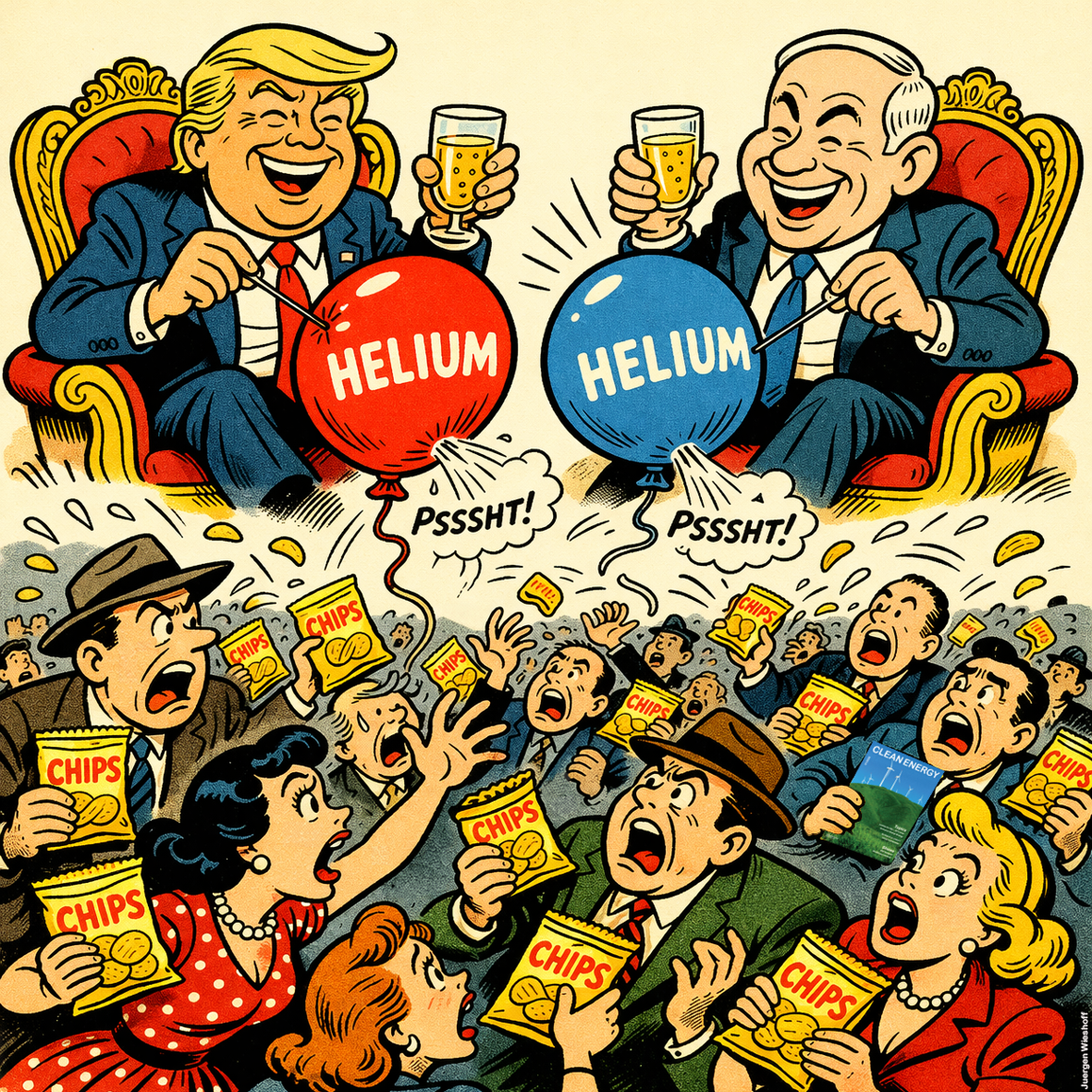
The Iran war just took one-third of the world’s helium offline. No helium, no chips. No chips, no AI. Most people have never heard of it. The resource nobody talks about is the one that matters most.
And it just got dramatically worse.
⚡ BREAKING — March 18, 2026
Israel struck South Pars — Iran’s side of the world’s largest gas field, which is geologically continuous with Qatar’s North Dome. Iran retaliated within hours, hitting Ras Laffan Industrial City again with missiles. Extensive structural damage. QatarEnergy’s verdict: repairs could take up to five years.
This is no longer a temporary disruption. It is structural.
🔬 What does helium have to do with chips?
Everything. Helium is the process gas for EUV lithography — the technology that prints the circuitry of every advanced chip at 3nm, 2nm and below. It cools superconducting systems. It creates inert environments where a single contamination event means scrapped wafers. There is no substitute. None.
„A lot of the world doesn’t run without semiconductors — and you can’t make semiconductors without helium, period.“
— Rich Gottwald, CEO, Compressed Gas Association
🗺️ The winners and losers — locked in for perhaps three to five years
🇺🇸 USA — Triple winner, now structural:
Largest helium producer (42.6% of global supply). Hormuz-immune. New US chip fabs — TSMC Arizona, Micron, Intel Ohio — get priority allocation. Linde and Air Products: up 14–15% YTD while the S&P is down 3%. This is no longer a trade. It’s a five-year strategic position.
🇨🇳 China — Double stranglehold, now permanent:
Import-dependent on Gulf helium. Already blocked from EUV machines by US export controls since 2023. Five-year Qatar outage eliminates the ’stockpile and wait‘ strategy entirely. The chip catch-up trajectory just got structurally interrupted.
🇹🇼 Taiwan — Strength becomes multi-year vulnerability:
TSMC produces 90% of the world’s most advanced chips. Majority of helium from Qatar. 97% energy import dependence. Only ~11 days of LNG reserves. South Pars and North Dome are the same geological field — the March 18 strike hits Taiwan’s supply chain on two levels simultaneously. And every week of TSMC vulnerability intensifies US pressure to onshore capacity — hollowing out the very sovereignty that made Taiwan indispensable.
🇰🇷 South Korea — Most exposed in Asia:
64.7% of helium from Qatar (Fitch, 2025). Five years. Samsung and SK Hynix are not watching the clock anymore. They are racing it.
🇪🇺 Europe — Still watching:
The EU Chips Act has billions for fabs. Zero strategy for process gas security. Helium isn’t even on the EU Critical Raw Materials list. With a five-year horizon now locked in, this is no longer a blind spot. It is an active threat to every European fab currently under construction.
⚡ The arithmetic of coincidence
On record: Trump stated the US knew nothing about the March 18 strike on South Pars.
On record: Netanyahu stated Israel acted alone.
On record: every measurable consequence of the strike — in helium supply, semiconductor allocation, industrial gas pricing, and chip fab geopolitics — flows in one direction.
The ancient legal principle Cui bono — who benefits? — was never meant as an accusation. It was meant as a question. A question that, in this case, the data answers with unusual clarity.
We leave it there.
Helium is the nervous system of chip production. Whoever controls the nerves controls the muscles. For the next five years, that control belongs overwhelmingly to one country.
📄 Full analysis: read it in the article. Here.
Fact-check, complete geopolitical scorecard, chronology, and what Europe must do now — before the five-year window closes.
Juergen Wieshoff
Editor-in-Chief, Clean Energy Magazine
Head of Governmental & Public Affairs, Flow Batteries Europe (FBE)
CEO, Wieshoff Consulting
Comments are closed